From twintip to foil: an interview with a kitefoil racer on switching disciplines
A kitefoil racer explains the honest trade-offs of switching from twintip to foil: wider wind range, sharper upwind angles, and real talk on crash risk.
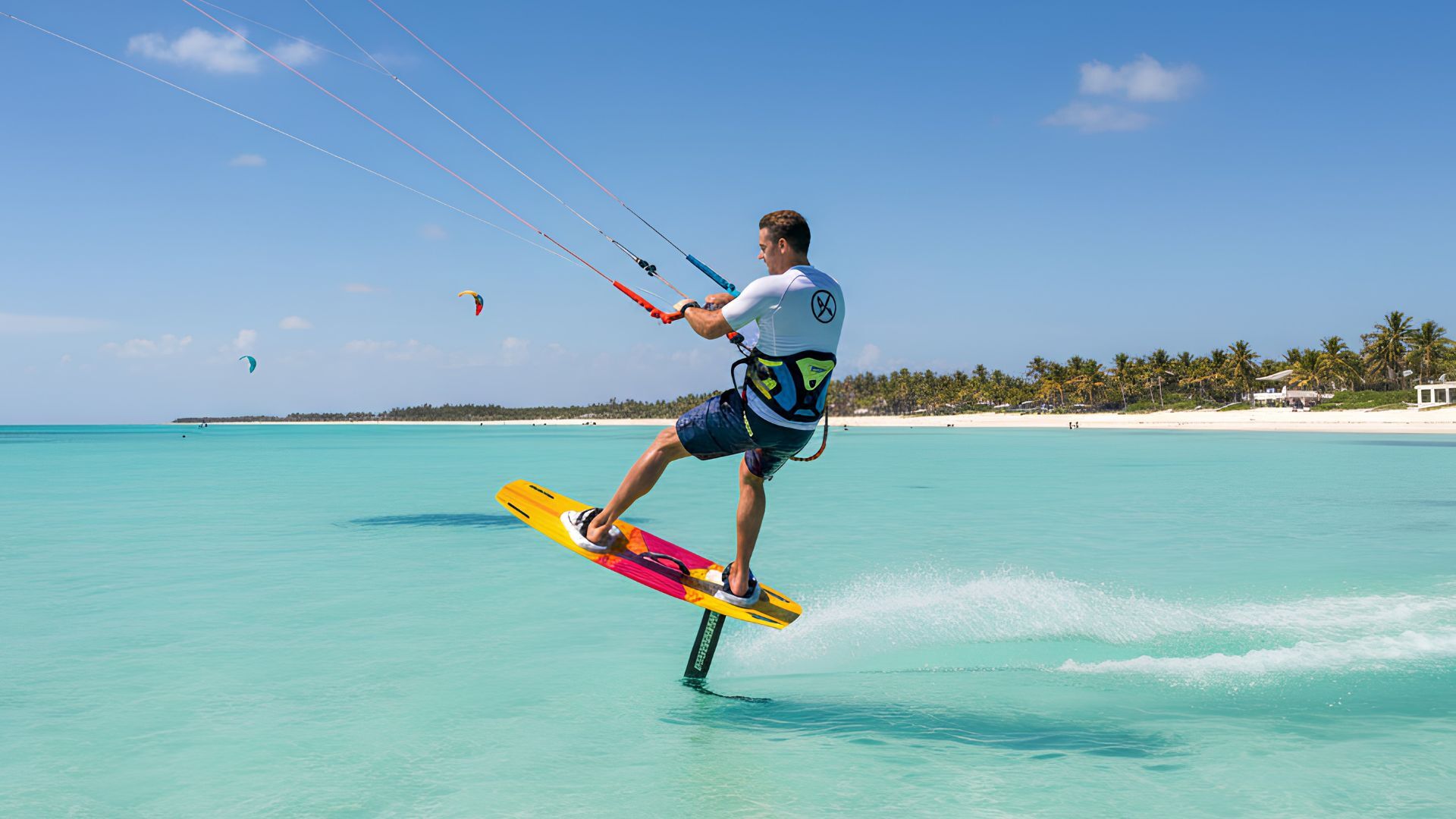
I met Freya Sandal at a car park in Portland Harbour, wind meter reading a scrappy 9 knots, her twintip still in the van and a five-metre race foil already pumped up on the slip. She's raced foil for three seasons on the UK circuit and a handful of European events, after eight years riding kitesurfing twintips. I wanted to know what actually changes when you swap a board that floats and slides for a mast that wants to fly — not the marketing version, the honest one.
4Shor: Let's start with the obvious one. Why switch?
Freya: Wind range, mostly. I was getting frustrated packing up at 10 knots on a twintip when the foil sailors were still out there grinning. On a race foil I'm comfortable from about 7 knots, sometimes less if the water's flat. That's a genuinely different sport in terms of how many days a year you can ride. If you check the kitefoiling hub on a marginal day, you'll often see the foil score sitting two or three points above the twintip score for identical conditions — that's not the app being generous, that's just physics. Less drag, more efficient lift, so you need far less power to get moving.
4Shor: What was the hardest part of the transition?
Freya: Standing up without immediately falling off the other side. I'm not joking — the first sessions were really humbling after years of twintip confidence. A foil has almost no forgiveness for weight distribution. Too far back and it breaches and slaps down; too far forward and it noses in. On a twintip you can be sloppy with your stance and the board just doesn't care. The foil cares immediately.
The second hard part was unlearning edge control. Twintip riding is all about how hard you dig your edge in to hold against the kite's pull. Foiling upwind is more about angle of attack and trim than brute edge pressure. I spent a good month riding worse than I had in years before it clicked.
4Shor: Talk to me about upwind angle — that's the bit twintip riders always ask about.
Freya: It's the single biggest performance difference and honestly the reason racing exists on foils at all. A decent twintip rider might hold 45 degrees off the wind on a good day. On a race foil I'm regularly at 30 to 35 degrees, sometimes tighter in flat water with a strong kite. That's not a small gain — it changes your whole route around a course, and it changes a normal beach session too. You can ride a session that would've meant three long downwind walks of shame on a twintip, and instead just tack back up the beach.
4Shor: And the downside — crash risk. People are wary of the mast.
Freya: Rightly so, to a point, wrongly so beyond that. Early on, yes, you fall in awkward ways: over the front, catching the wingtip, the classic cartwheel when you overload the mast in chop. The mast and wing are hard and they don't bend like a twintip edge does, so a bad fall can sting more, and shallow or rocky water is genuinely a bigger deal than it is on a twintip. I wouldn't learn to foil somewhere I'd happily learn twintip basics, like a rocky reef break; I'd want flat, deep, obstruction-free water, ideally somewhere similar to what we recommend for anyone starting out at all, like the spots covered in kitesurfing for beginners.
But once you're competent, I'd argue the foil is calmer, not more dangerous. You're not getting dragged and bounced across chop the way you can on a twintip in gusty onshore wind. Most of my foil injuries have actually been bruised pride rather than bruised body.
4Shor: What conditions suit foil racing that don't suit twintip, and vice versa?
Freya: Foil wants clean wind and, ideally, flatter water — chop unsettles the mast more than it unsettles a twintip's hull. Gusty thermal wind, the kind you get on a lot of Mediterranean afternoons, is actually lovely on a foil because you don't need the gust to keep moving. Twintip still wins hands down when it's genuinely windy and choppy — 20-plus knots with a slop on it is a twintip session, not a foil one, unless you're specifically training in survival conditions. If I'm reading a forecast and it's a solid 8/10 for kitesurfing with 18 knots and a metre of swell, I'm grabbing the twintip. If it's a marginal 5/10 with 10 knots and flat water, that's often a 7 or 8 for foil.
4Shor: Advice for a twintip rider curious about trying foil?
Freya: Borrow before you buy — foils are expensive and everyone's setup preference is different. Pick a genuinely light-wind day for your first sessions, not a howling one; you want time to think, not survive. Expect to feel incompetent for a few sessions, that's normal and it passes fast. And respect the hardware around other people — a race foil moving at speed near a crowded beach line is not the place to be finding your feet. Find flat, open, deep water, get a friend who already foils to watch your first few goes, and don't judge the sport by session one.
4Shor: Would you go back to twintip only?
Freya: No, but I haven't given it up either. I still ride twintip when it's proper windy and I want to throw the kite around. The foil just gave me a whole extra category of days that used to be write-offs. That's the real pitch, if there is one: it's not really twintip versus foil, it's twintip and foil, covering more of the wind chart between them than either does alone.
More stories
 Comparison
The best water-sports forecast apps in 2026
An honest, sport-by-sport look at the forecast apps worth your time — Surfline, Windy, Windguru, Windfinder and 4Shor — and which one fits how you ride.
 Field notes
Paddleboarding into the Witches Cauldron, Pembrokeshire
Moving our Pembrokeshire trip to a calmer Friday evening so Sarah, new to paddleboarding, could SUP through the arch into the Witches Cauldron — and out at sunset.
 Field notes
Three days chasing wind in Tarifa
A first-person diary of a long weekend on the Strait of Gibraltar — reading Levante against Poniente, rigging up, and the session that made the trip.
Find your next session.
4Shor scores every spot for your sport and ability, up to 8 days ahead — so you always know when to go.