
Surfing for beginners: catching your first waves
The conditions to look for, the ones to avoid, and how to pick a beginner-friendly beach and tide so you spend more time up and riding.

Nothing about surfing is harder than the first few months — and almost all of that difficulty comes down to one thing: choosing the right conditions. Get the waves, wind and tide right and progress feels inevitable. Get them wrong and you spend an hour being tumbled in the shore break. This is a beginner's guide to reading a beach before you paddle out.
Start in the whitewater
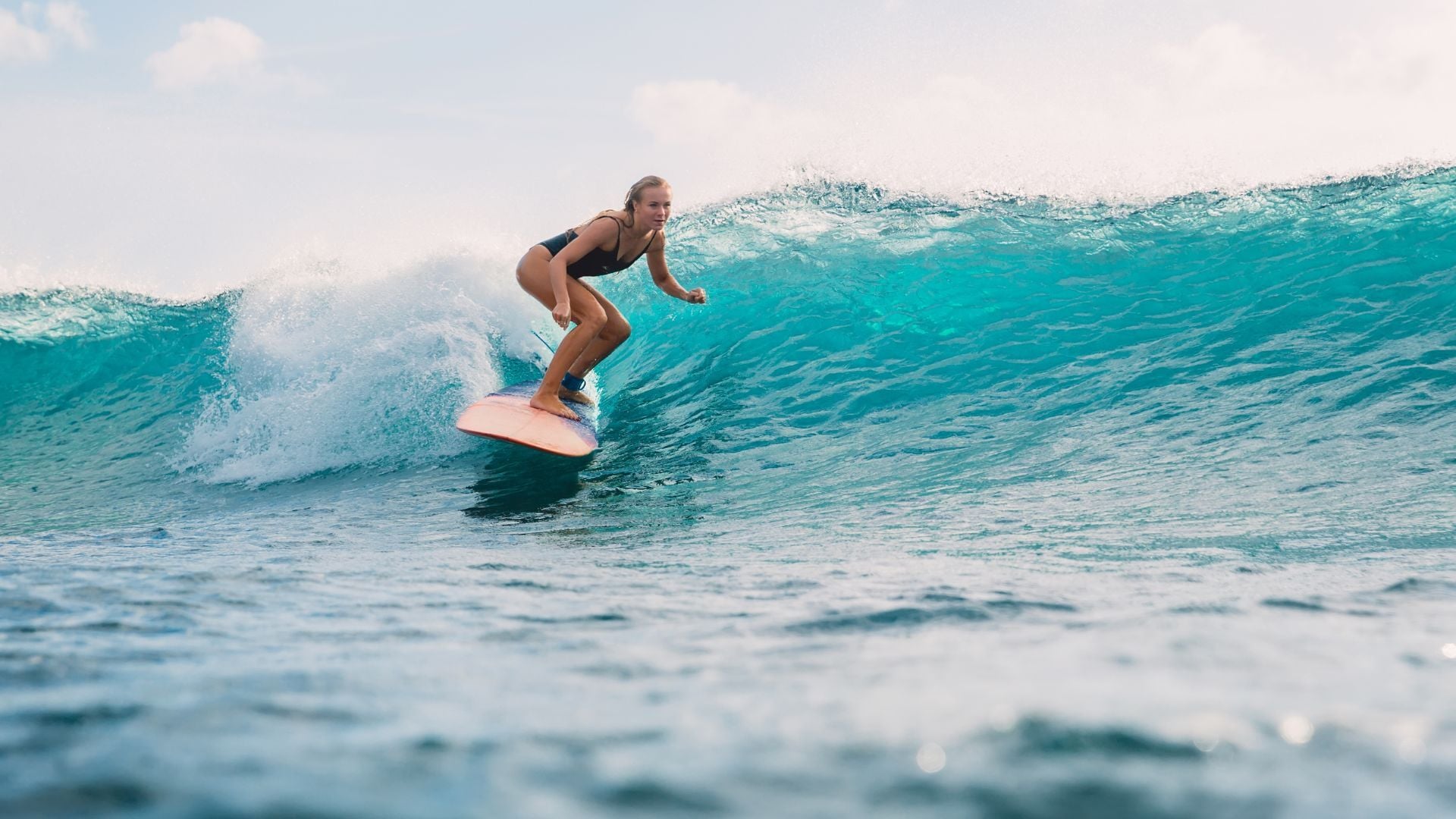
For your first sessions you are not looking for the peeling green faces you see in videos. You want small, broken waves — the foamy whitewater that rolls in after a wave has already broken. It has plenty of push, it is forgiving, and it lets you practise the two skills that matter most at the start: popping to your feet and pointing the board where you want to go.
A knee-to-waist-high day that a seasoned surfer would call "flat and useless" is very often the perfect beginner day. Don't be put off by a modest forecast.
The three numbers that decide your session
Every surf forecast comes down to three things. As a beginner you want all three pointing towards small and clean:
- Swell height — aim for roughly 0.3–1 m at a beginner beach. Big enough to catch, small enough to be safe.
- Swell period — the seconds between waves. Short periods (6–9s) produce gentler, weaker waves that suit learning. Long-period groundswell packs far more power than it looks.
- Wind — light wind is your friend. Under about 10 knots the sea stays smooth; a light offshore or glassy morning is ideal. Strong onshore wind turns the sea into messy, choppy soup.
If you want the full breakdown of these three, we wrote a dedicated guide: how to read a surf forecast.
Tides matter more than you think
Most beaches have a tide state that works and one that doesn't. On many mellow beach breaks the couple of hours around low or mid tide give the cleanest, most gradual waves. Steep shore-dumping at high tide is no fun on a foamie. Ask at the local surf school, or watch the beach for a session before you commit — the difference is dramatic.
Pick a friendly beach
A gently shelving sandy beach break with a lifeguard is the safest classroom. Avoid reefs, points and anywhere with strong rips until you can confidently read the water. If in doubt, book a lesson — an instructor will put you in the right spot at the right time, which is worth ten sessions of guessing.
A quick safety checklist
- Never surf alone, and tell someone your plan.
- Learn to spot a rip current — a channel of darker, calmer-looking water moving out to sea. If caught, don't fight it; paddle across it, parallel to the beach.
- Always keep hold of your board and be aware of others around you.
- Check water temperature and wear enough wetsuit — cold saps energy fast.
Let the forecast pick your day
Reading all of this for every beach, every day, gets tiring — which is exactly why we built 4Shor. Tell it you're a beginner surfer and it scores each spot from 0–100 for your ability, folding swell, period, wind and tide into a single honest number. A "70 for a beginner" is a genuinely good learning day, not an expert-only one.
Explore what 4Shor scores for surfing, or browse beaches near you and let the daily score tell you when to paddle out.
More stories
 Comparison
The best water-sports forecast apps in 2026
An honest, sport-by-sport look at the forecast apps worth your time — Surfline, Windy, Windguru, Windfinder and 4Shor — and which one fits how you ride.
 Field notes
A surf weekend in Cornwall
Two days chasing clean waves along the north Cornwall coast — dawn patrols, tide windows, and letting the forecast decide which beach to drive to.
 Forecasting
How to read a surf forecast: swell, period and wind
Swell height gets all the attention, but period and wind decide whether it is clean and rideable. A plain-English guide to the numbers that matter.
Find your next session.
4Shor scores every spot for your sport and ability, up to 8 days ahead — so you always know when to go.