Wing foiling vs kitesurfing: which should you learn first?
Choosing between wing foiling and kitesurfing for your first lesson? Here's how the learning curve, cost and wind range actually compare.
You're at the beach school noticeboard, sun on the back of your neck, and there are two boards on offer: a small foil board with a handheld wing, and a twin-tip with lines running up to a kite. Both promise the same thing — gliding across flat water, wind in your face, minimal effort once you're up and running. Both cost roughly the same to learn properly. So which one do you actually book first?
The honest answer is: it depends on what kind of frustration you can tolerate, and how much wind your holiday actually gives you.
The learning curve, honestly
Kitesurfing has more moving parts to master before you're anywhere near a board. You need to learn to fly the kite on its own — power strokes, depower, relaunching it from the water — and that's a session or two of standing on the beach with lines in your hands before an instructor lets you near a board at all. Body-dragging (being pulled through the water by the kite, no board, just you) is the next stage, and it teaches kite control under real load. Only then does the board come in. Most schools budget 9-12 hours of lessons to get someone independently riding upwind, and that's if the wind cooperates every day.
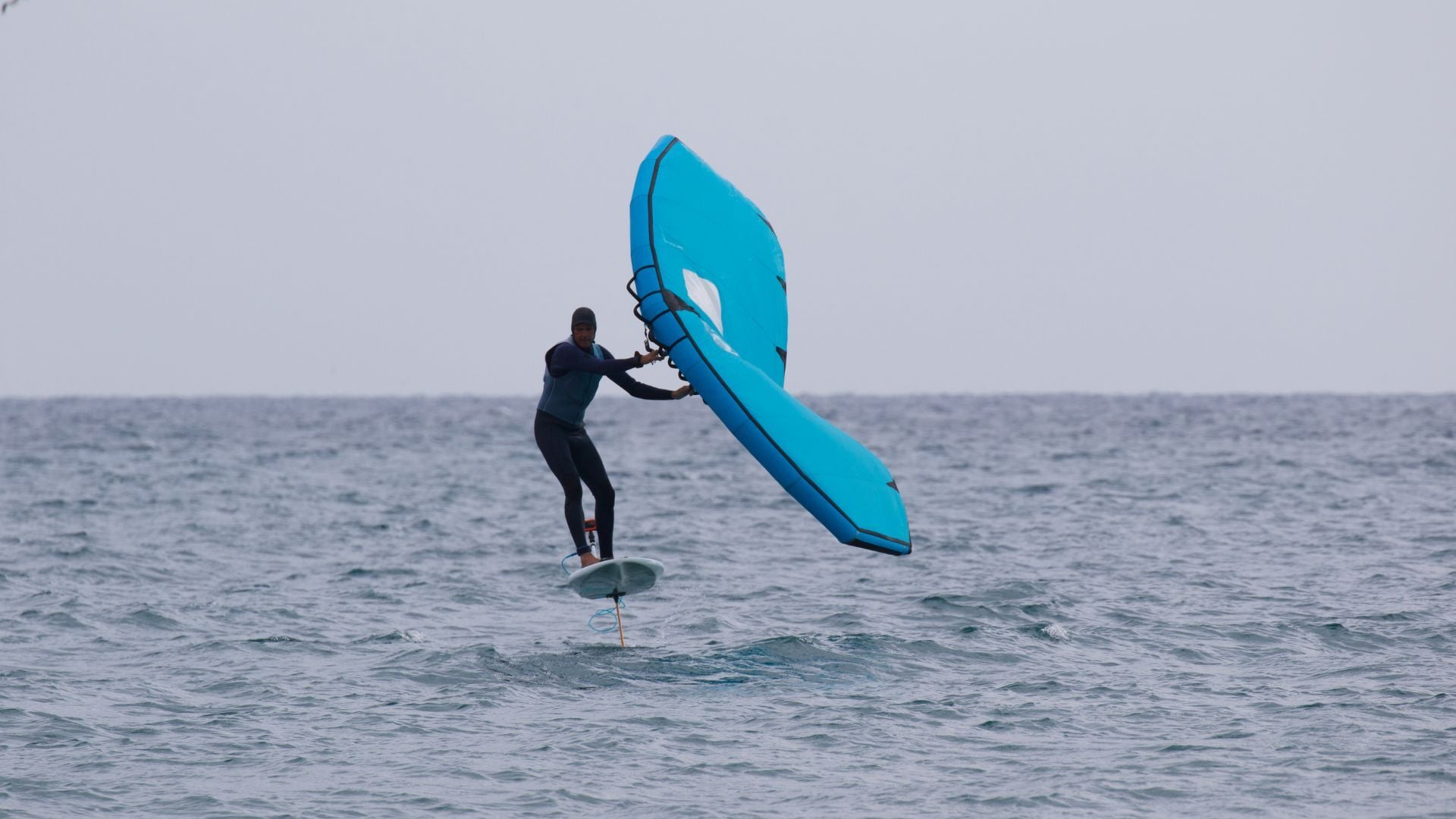
Wing foiling front-loads differently. The wing itself is intuitive within the first half hour — it's handheld, there's no line management, no relaunch drama, and if you let go it just flops on the water and stays there. The genuinely hard part is the foil: standing on a board with a hydrofoil underneath demands a level of balance and pumping technique that a normal board doesn't. Beginners often get the wing sorted quickly, then spend several sessions falling off a foiling board before the pieces click. Once they do, though, progress tends to be quick — riders often link their first proper runs within 4-6 hours of dedicated foil time, especially if they've had any prior boardsports experience (surfing, SUP, snowboarding all transfer).
So: kitesurfing has a longer, more technical entry gate (the kite) but a gentler board (twin-tips are stable, forgiving, and don't buck you off for standing still). Wing foiling has a shorter gate but the foil punishes hesitation. Neither is "easier" in absolute terms — they're hard in different places.
Kit and cost
For a first season, a wing foiling kit costs slightly less to get going with, mainly because you don't need a bar, lines, a pump for a kite bladder, or a safety leash system as elaborate as a kite's. A usable beginner wing-foil set-up (wing, board, foil) runs somewhere in the £1,800-£2,500 range new; kitesurfing kit (kite, bar, board, harness) tends to sit a bit higher, partly because you often want two kite sizes to cover a realistic wind range, and partly because kite bladders and bar lines are wear items you'll be replacing.
Both sports rent kit at beach schools for broadly similar day rates, so this only matters once you're committed and buying your own. If you're not sure you'll stick with it past one holiday, rent both and let your body decide — don't buy before you've fallen in the water enough times to know which frustration you enjoy more.
Wind range — the bit holidaymakers underestimate
This is where the two sports genuinely diverge, and it's worth reading properly before you commit a week of holiday to one over the other.
Kitesurfing wants a fairly narrow and consistent band, roughly 12-25 knots depending on your kite size and weight — too little and the kite won't generate enough power to get you up and riding; too much and it becomes a safety and strength issue, especially for a first-timer. Big kites (12-17m) exist for light days, but light-wind kiting is genuinely one of the harder disciplines, not a good beginner entry point.
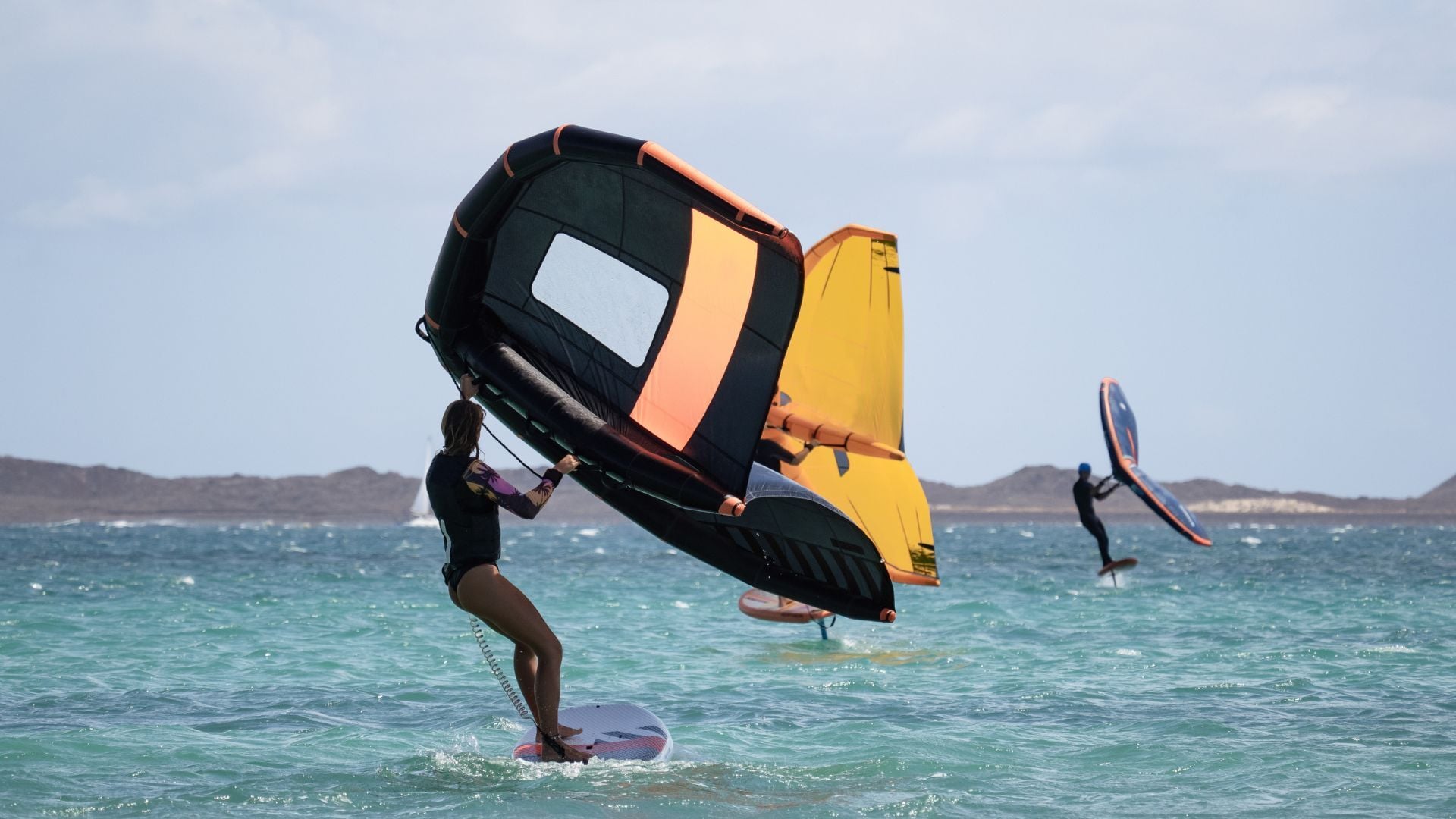
Wing foiling has a wider comfortable window, roughly 10-25 knots, and — crucially for a beginner — the foil itself generates lift at low boat speed, so a 10-12 knot day that would leave a kitesurfer standing on the beach can still give a wing foiler a proper session. That wider range is why wing foiling has become the go-to recommendation for people on trips where wind is inconsistent, like most Mediterranean thermal locations outside the core meltemi window, or UK coastal weeks where a forecast might swing from 8 knots to 20 across a single day.
If you're planning around a forecast, it's worth actually understanding what the numbers mean for the sport you pick — our guide to reading the wind for kite and wing breaks down how a 4Shor score translates into a rideable session for each, rather than just a green tick or a red cross.
Do the skills transfer?
Mostly yes, and this is the good news if you can't decide — neither choice is wasted. Riders who learn kitesurfing first arrive at wing foiling already comfortable reading wind direction, working out a beach launch, and riding a board with their feet not strapped in a fixed stance. What they have to relearn is foil balance and the pumping technique that keeps a foil flying, which has no kite equivalent.
Riders who learn wing foiling first bring good board feel, wind-window awareness, and comfort being blown around by a sail-like object. What they lack going into kitesurfing is kite-specific muscle memory — bar pressure, depower, relaunch — which is a distinct skill set you can't shortcut.
Neither sport teaches you the other's hardest bit, in other words. But both teach you to read a beach, judge a gust, and respect a lull, and that groundwork carries over completely.
So which one first?
If your holiday wind is going to be marginal or patchy — a lot of 10-15 knot afternoons rather than a reliable 18-20 — book wing foiling. You'll get more days on the water for the same forecast, and the wingfoiling hub is a good place to check what wind range your local school actually needs before you commit lesson money.
If you've got a genuinely windy week booked — somewhere like Tarifa in peak season, or a Canaries base in winter — and you like the idea of eventually jumping and riding powered-up, kitesurfing rewards that consistency, and the kitesurfing hub has the detail on what kite sizes and conditions suit a first-timer. If you're leaning that way, it's worth reading through what a first week actually looks like in our piece on kitesurfing for beginners before you book — it'll save you turning up with the wrong expectations about how much beach-based kite flying comes before you ever touch a board.
Either way, don't judge the sport by your first two hours. Kitesurfing's kite-flying stage feels tedious until it isn't; wing foiling's early falls feel endless until the foil suddenly, almost without warning, just lifts and holds. Both moments are worth the build-up.
More stories
 Forecasting
Reading the wind for kite & wing: strength, direction and gusts
Wind speed is only half the story. Here is how to read direction, gust factor and squalls so you rig the right kite or wing every time.
 Comparison
The best water-sports forecast apps in 2026
An honest, sport-by-sport look at the forecast apps worth your time — Surfline, Windy, Windguru, Windfinder and 4Shor — and which one fits how you ride.
 Field notes
Paddleboarding into the Witches Cauldron, Pembrokeshire
Moving our Pembrokeshire trip to a calmer Friday evening so Sarah, new to paddleboarding, could SUP through the arch into the Witches Cauldron — and out at sunset.
Find your next session.
4Shor scores every spot for your sport and ability, up to 8 days ahead — so you always know when to go.